Water Vapor Change Diagrams
Written by Adi Ackerman, Head Teacher
"Water Vapor Change Diagrams" is written for 2nd Grade (Ages 7-8), and it covers NGSS 2-PS1-4. If your little one is a year younger but already steady on material properties, the page still works. You may just need to read the instructions out loud. And if they are older and physical changes never quite stuck, this is a short review rather than busywork.
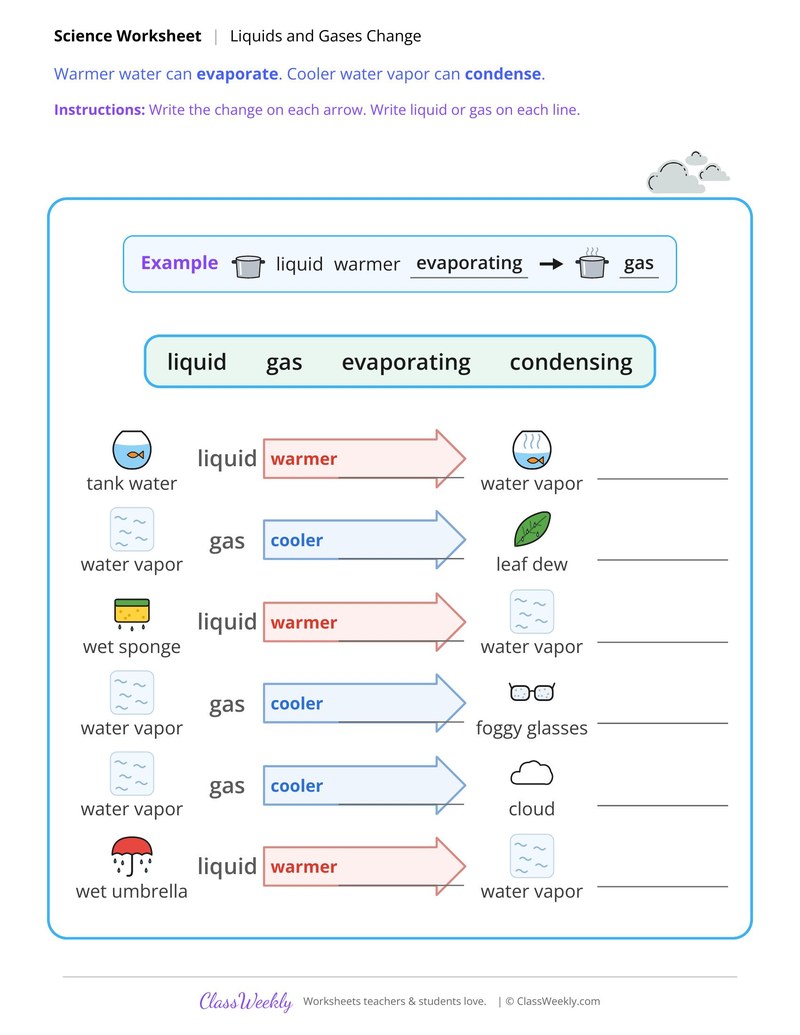
2nd grade science worksheet: write evaporating or condensing and liquid or gas on diagrams for leaf dew and foggy glasses. Answer key included. Part of our physical changes material properties collection. Aligned to NGSS standards.
How do I use this worksheet?
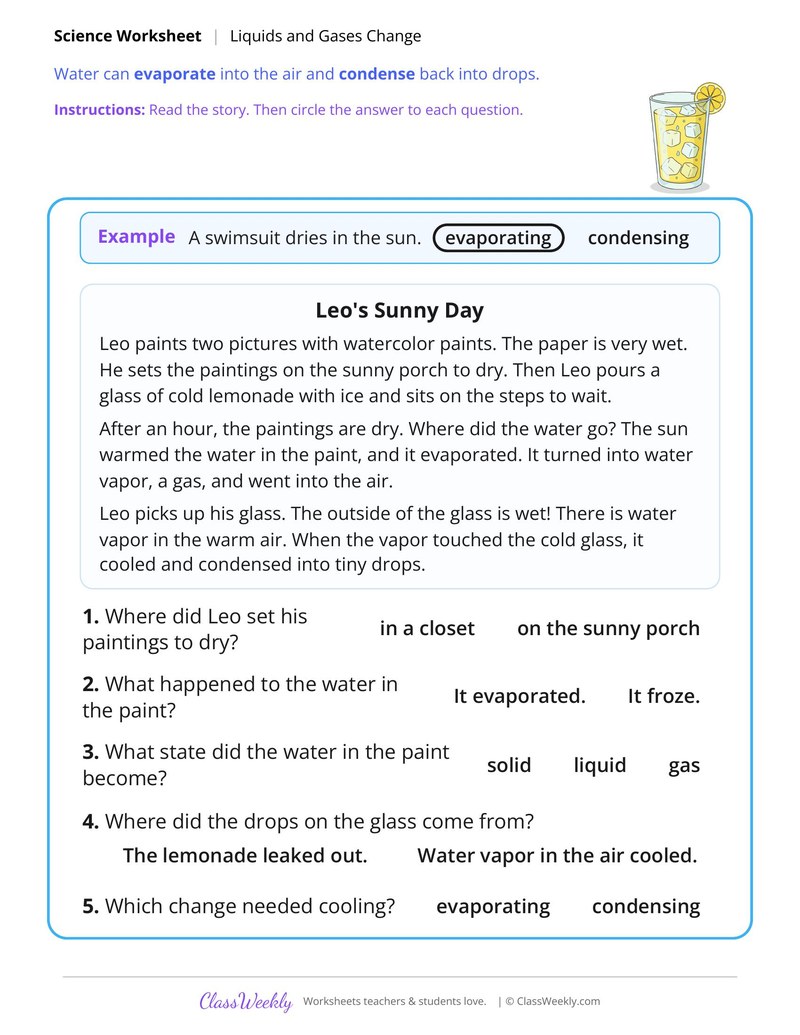
Give your child a set of building blocks: build one thing, take it apart and build something new from the same pieces. Then read the passage together and check each page with the answer key.
What students will practice
- Students will read warmer and cooler arrows on change diagrams.
- Students will write evaporating or condensing for tank water, a wet sponge and a cloud.
- Students will write liquid or gas on each line.
Curriculum Links
Next Generation Science Standards
Science · 2nd Grade
Find this in the curriculum
Browse the grade, subject, and topic this belongs to.
FAQ
How do I use this physical changes worksheet?
⌄
Give your child a set of building blocks: build one thing, take it apart and build something new from the same pieces. Then read the passage together and check each page with the answer key.
What does this worksheet teach?
⌄
Write evaporating or condensing and liquid or gas on diagrams for leaf dew and foggy glasses. The directions on the page read: Write the change on each arrow. Write liquid or gas on each line. The page opens with a worked example, and an answer key is included.
Can I use this physical changes worksheet for homeschool or classroom?
⌄
Yes, both. We made it for 2nd Grade material properties, and the page works the same whether it lands on a kitchen table or a center rotation. At home, most families go through it together and talk the answers out loud, and that talking is where most of the learning happens with physical changes. In class it runs well as independent work while you pull a small group. Print one copy or thirty, whichever the day needs.
What is a physical change?
⌄
A physical change changes the size, shape or form of a material, but it is still the same material. When modeling clay is rolled into a snake and pressed into a bowl, it changes shape but is still clay. Melting and freezing are physical changes too.
How can small pieces make a new object?
⌄
Many objects are made of small pieces put together. On the toy brick page, Riley takes a house apart and uses the same 24 bricks to build a boat. The bricks do not change; only the shape they make does (2-PS1-3).
What holds a brick wall or a log cabin together?
⌄
Mortar, a wet paste that dries hard, holds bricks together so they cannot slide. Log cabin builders cut a cup shaped notch near each end of a log so the logs fit at the corners, then fill the gaps with mud or a paste to keep out the wind and the cold.
Do these worksheets have answer keys?
⌄
Yes. All 6 sheets have an answer key.
Ratings & Reviews
No reviews yet. Be the first to share what you think.
Reviews are for ClassWeekly members.
Make a Request
Spotted something to fix, or want a worksheet we don't have yet? Tell us and we'll make it.
Worksheet Details
| Grade | 2nd Grade |
| Subject | Science |
| Topic | Material Properties |
| Standard | 2-PS1-4 |
| Pages | 1 page |
| Difficulty | Medium |
Learn More
What is ClassWeekly?
ClassWeekly offers free worksheets and printable learning resources for kids, from preschool up. All worksheets are aligned to Common Core, NGSS, and C3 Framework standards and designed by educators. Become a member to access the full library and download unlimited PDFs.